Destinations
Holidays in Germany Without a Car: Regions That Work by Rail
Contents9 sections
- Why a car-free holiday in Germany is planned differently
- Coast by rail: Baltic and North Sea with coastal railways and ferries
- Low mountain ranges with a guest card: Black Forest, Harz, Saxon Switzerland
- The Alpine fringe without your own car: Berchtesgaden, Zugspitze, Allgäu – and what remains open for the lakes
- The guest card as the key: how public-transport-inclusive systems work
- Reading the season: when which regions are quiet
- Choosing a region: reachability before fame – a checklist
- Typical mistakes: forgetting the last mile, high season, too many places
- Conclusion
A good fifth of all holiday trips by Germans stay within the country. Yet on the longer trips only a small fraction of travellers sit on a train.[1] Across all multi-day trips the railway reaches almost a fifth, the car around sixty percent.[2] The gap is rarely a question of distance. It opens on the last mile: at the station where nobody knows how to get on to the accommodation. That is where a car-free holiday in Germany either turns relaxed or ends in changing trains and waiting.
Why a car-free holiday in Germany is planned differently
If you drive, you choose the region by reputation and sort out local mobility later. If you travel without a car, you have to reverse the order: first check how the region works from the inside, then book. Three questions are enough.
First: is there a station at or near the destination with long-distance or reliable regional service? Second: what takes over from there – regional bus, coastal railway, ferry or mountain railway? Third: is that mobility included in a guest card that your host hands out?
In our view the third question matters most. It separates regions that structurally support going without a car from regions that merely tolerate it. The sections below show where that structure demonstrably exists.
Coast by rail: Baltic and North Sea with coastal railways and ferries
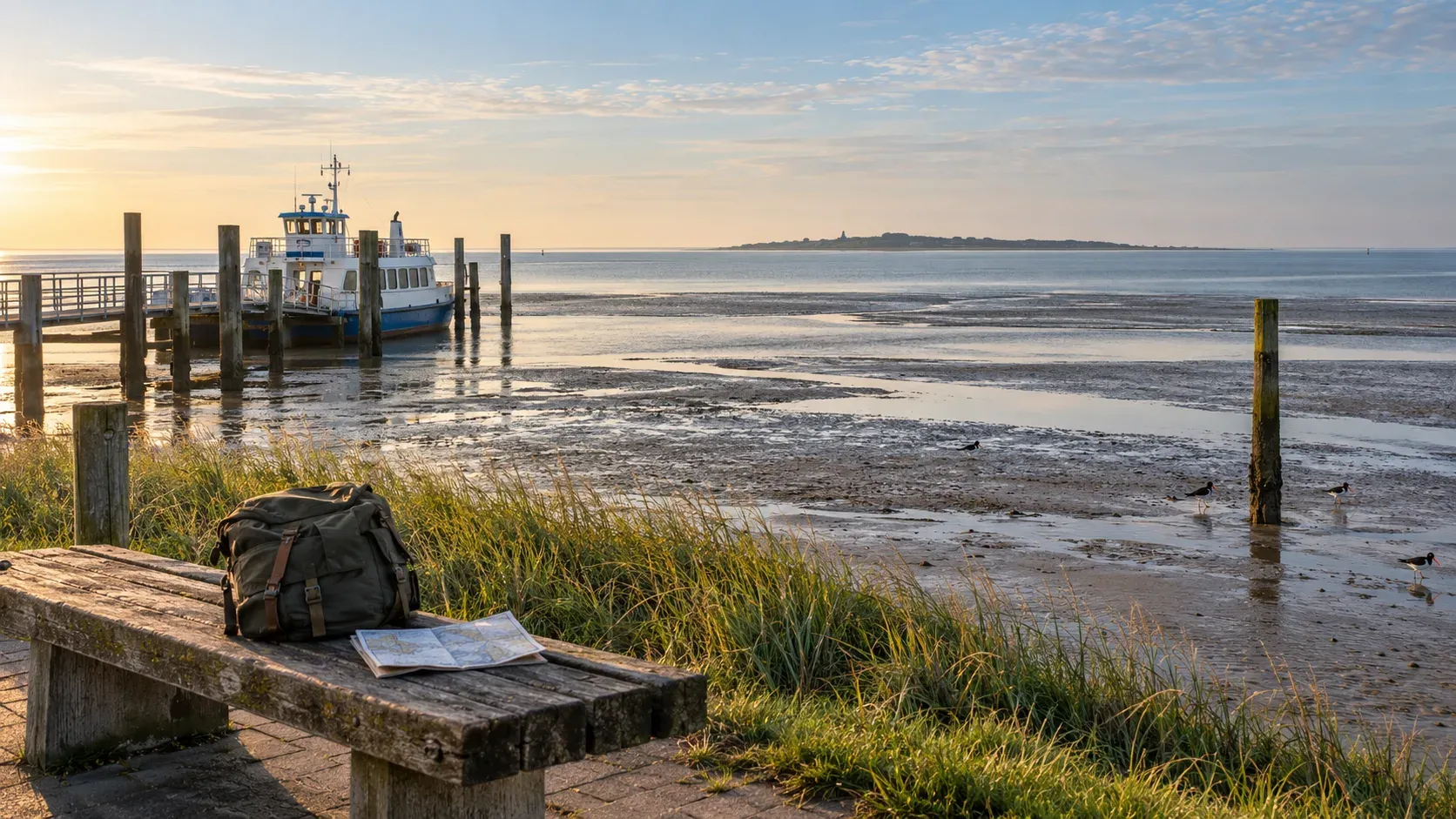
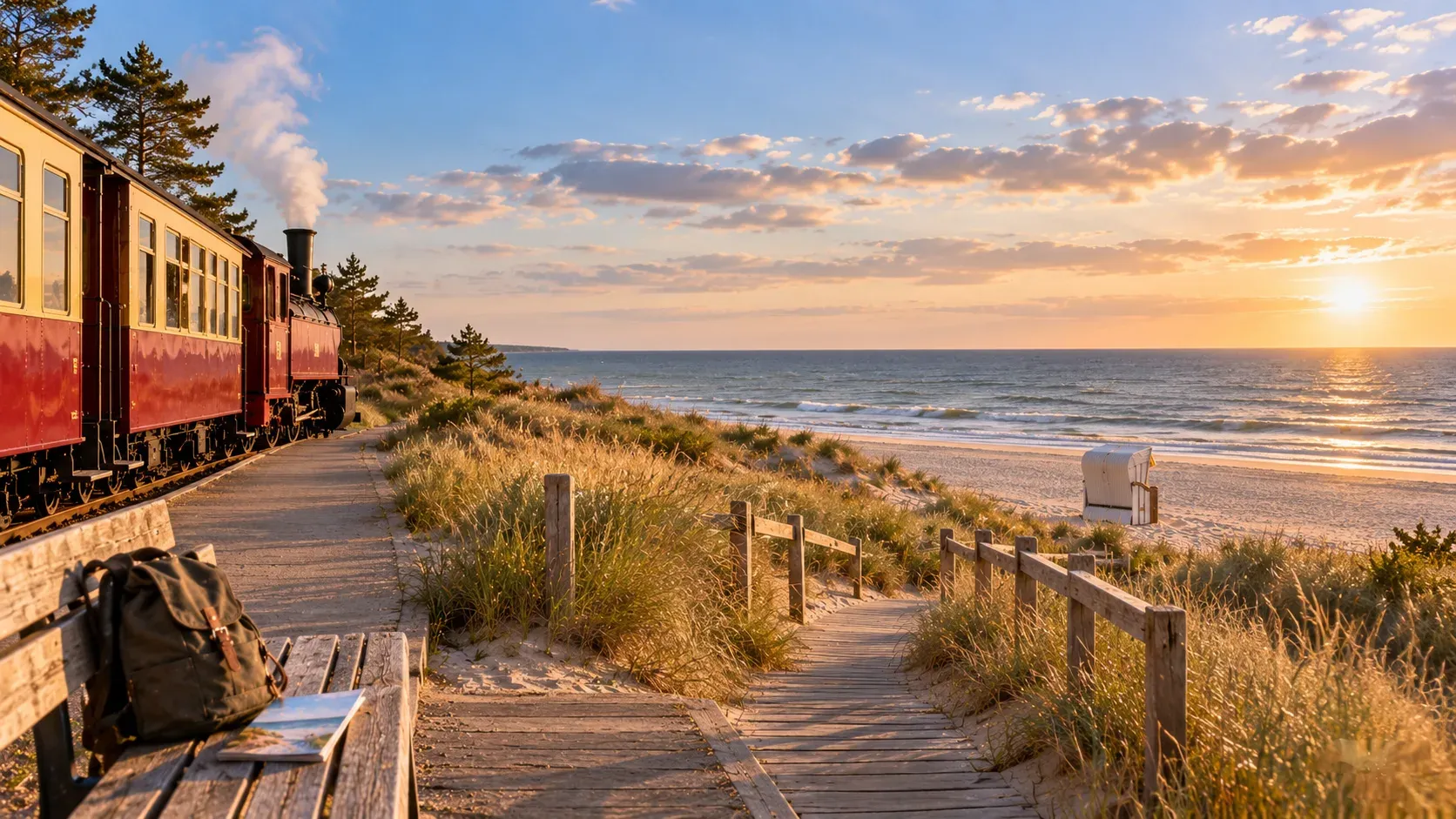
The coasts are a region type with a strongly pronounced summer peak.[3] Rügen shows what onward mobility can look like there. At Bergen auf Rügen a standard-gauge line branches off via Putbus to Lauterbach Mole. Between Putbus and Lauterbach Mole the narrow-gauge Rasender Roland shares the track with standard-gauge trains.[4]
Whether this pattern of main-line station, interchange and coastal railway repeats at other coastal towns is something we have not checked; in our view ferries and island railways are the obvious variants. Details on towns, islands and tides belong in separate pieces on the Baltic and the North Sea. For choosing a region, one finding is enough: the coast is doable without a car, but has its demand peak in high summer.[3]
Low mountain ranges with a guest card: Black Forest, Harz, Saxon Switzerland
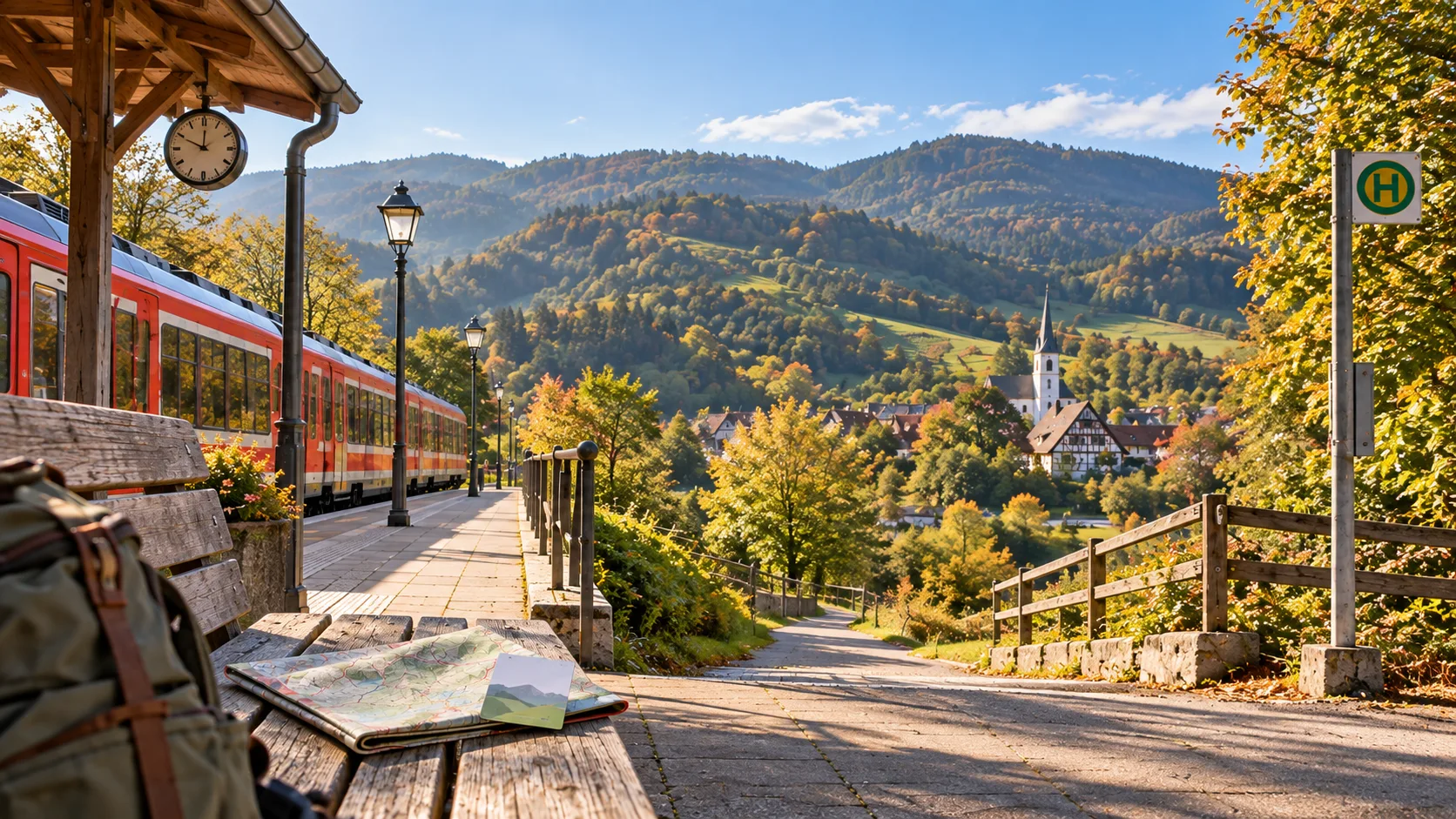
The low mountain ranges are the region type where the guest-card idea is most developed. In the Black Forest, accommodation providers hand out the KONUS guest card at check-in; businesses exempt from the visitor’s tax, such as youth hostels or clinics, cannot issue it.[5] The card is valid on second-class buses and trains across nine regional transport associations between Pforzheim and Basel and between Karlsruhe and Waldshut. Long-distance trains and mountain railways are excluded.[5]
In the Harz the Harzer Urlaubsticket, HATIX for short, works on the same principle: guests in participating towns receive it only after paying the visitor’s tax or guest contribution, as a guest card or ticket booklet with the registration form.[6] It is valid on buses and trams in the districts of Harz, Goslar, Göttingen and Mansfeld-Südharz, in the latter two only on selected routes; the Harz narrow-gauge railways are not included.[6] You reach the Harz National Park via regular stations on its edge such as Goslar, Bad Harzburg, Wernigerode, Herzberg or Walkenried; inside the protected area buses and the narrow-gauge railway take over, and the region carries the “Fahrtziel Natur” label.[7]
Saxon Switzerland shows that a national park can even sit on the long-distance network. Bad Schandau is an international EC stop with direct trains from Berlin, Leipzig, Prague and Vienna among others, plus the S-Bahn from Dresden. From the station an Elbe ferry and hiking bus routes lead into the protected area.[8] For the Bavarian Forest we have no verified evidence on the guest-card mechanics; that region belongs on the checklist, not in the recommendation.
The Alpine fringe without your own car: Berchtesgaden, Zugspitze, Allgäu – and what remains open for the lakes
On the Alpine fringe the onward mobility often starts right on the platform. The trip up the Zugspitze starts with the Bavarian Zugspitze Railway directly at Garmisch-Partenkirchen station.[9] You reach Berchtesgaden National Park via Berchtesgaden station with its long-distance connection and then by regional bus to the park entrances; inside the national park private car traffic is not permitted.[10]
The guest card of the Berchtesgaden region is handed out by the accommodation provider on arrival or made available digitally from the day you arrive; it is tied to the visitor’s contribution you pay directly to your host.[11] With it you travel free on the entire regional bus network and by train within the region, for instance to Bad Reichenhall or the Rupertiwinkel; special routes such as the Kehlstein railway or trips to Salzburg are excluded.[11]
In the Allgäu the Allgäu-Walser-Pass Premium includes the MOBIL PASS ALLGÄU. It is valid on buses and local trains in the municipality of Oberstdorf, in the Upper and Western Allgäu, to and within Kempten and into the Tannheim valley. Individual routes in the Bregenzerwald and the Lake Constance district are included as well; certain tourist private bus routes are excluded.[12] For Lake Constance and Chiemgau as lake regions in their own right we lack verified evidence on guest-card mechanics; both belong on the checklist.
The guest card as the key: how public-transport-inclusive systems work
The three verified systems – KONUS, HATIX and the Berchtesgaden guest card – follow a shared pattern. The accommodation provider issues the card, issuing is tied to the visitor’s tax or guest contribution, and validity is regional rather than nationwide, with exceptions for long-distance trains and special railways.[5][6][11] That is our summary of three individual cases, not an official definition.
| Region type | Station with long-distance link | Onward mobility | Guest card with transport | Verified example |
|---|---|---|---|---|
| Coast | yes, on the main line | coastal railway, ferry | not checked | Rügen: Bergen – Putbus – coastal railway[4] |
| Low mountain ranges | yes, on the edge or an EC stop | regional bus, narrow-gauge railway, ferry | yes | Black Forest KONUS[5], Harz HATIX[6], Bad Schandau[8] |
| Alpine fringe | yes, at the destination | regional bus, rack and mountain railways | yes | Berchtesgaden[10][11], Allgäu[12] |
| Lakes | not checked | not checked | not checked | no verified evidence |
(The table shows four region types with rail access, onward mobility and guest-card status; coast, low mountain ranges and Alpine fringe are verified, for lakes the evidence is missing.)
Why not one card for everyone? In our view it comes down to the coupling: each of the three cards hangs on a municipal levy that is only charged where you stay overnight.[5][6][11] For you that means: the card is valid in the region where you stay overnight and ends at its border.
Reading the season: when which regions are quiet
The official monthly statistics show a different annual profile for each region type. The coastal regions have a strongly pronounced seasonality with the overnight-stay peak in July. The Alps with their foothills also show a summer peak, but are more heavily used outside summer thanks to winter tourism. Low mountain ranges and cities spread their demand far more evenly across the year.[3]
For the Alps the Federal Statistical Office even evaluates the winter season separately, for seven officially defined travel regions from the Allgäu to the Chiemgau.[13] In one such winter evaluation guests in the Alps stayed on average about one night longer than the national average.[13] In our view that is an indication of a second season for the Alpine regions, no more; the evaluation offers no comparison with other region types.
For lake regions there is no separate official statement on seasonality: the indicator distinguishes only coast, Alps, low mountain ranges and cities.[3] If you want a lake, you have to derive the season from its setting, whether Alpine foothills or lowlands. How to read climate data for that is covered in our piece on the best time to travel with a climate table.
Our conclusion from this: if you travel without a car and want quiet, choose the low mountain ranges almost regardless of the month, the coast outside high summer and the Alps in the shoulder periods between the summer and winter seasons.
Choosing a region: reachability before fame – a checklist
The best-known region is rarely the one that works best without a car. How to find alternatives to overrun destinations is the subject of our piece on dupe destinations. For the decision itself this order is enough:
- Check the station: a long-distance stop in the town or a regional station with a direct connection from your city.
- Check the last mile: how do you get from the station to the accommodation, and back?
- Check the guest card: does the host issue a card with public transport included, and which routes are excluded?
- Check the exceptions: in all three verified systems, mountain railways, narrow-gauge railways or special routes are extra.[5][6][11]
- Check the season: avoid the coast in July, low mountain ranges year-round, the Alps in the shoulder periods.
- Check the radius: one valley, one town, one rhythm. How that feels over two or three days is described in our piece on short breaks and weekend trips.
- Only then book the accommodation – in the municipality whose card you want to use.
Typical mistakes: forgetting the last mile, high season, too many places
The most common mistake is accommodation outside the card area. If you stay in the Black Forest with a business that is not allowed to issue the KONUS card, you pay for every bus ride yourself.[5] Before booking, check whether the business issues the card, not just whether the region has one.
The second mistake is assuming “guest card” means “all inclusive”. In the Harz the narrow-gauge railways are excluded, in the Black Forest the mountain railways, in Berchtesgaden the Kehlstein bus and the trip to Salzburg.[5][6][11] Precisely the attractions many people come for are on the exclusion list.
The third mistake is changing region mid-holiday. The verified guest cards end at their regional border because they are tied to a municipal levy; in our view a card that works differently would be the exception. Two regions in one week mean two cards, two registrations and a journey without a card in between. Without a car, one base with day trips is almost always the better choice than a round trip.
Conclusion
Germany without a car works where three things come together: a station with a connection, an organised last mile and a guest card that the host hands out. That is demonstrably the case in the Black Forest, the Harz, Saxon Switzerland, Berchtesgaden and the Allgäu; on the coast the coastal railway carries the load, in summer at the demand peak.[3][5][6][11] Choose the region by this structure, not by its fame, and book the accommodation only once you know which card it will put in your hand.
References
[1]: Reiseanalyse 2026 – First Results (brochure, German) (opens in a new tab) – association study (FUR e.V.), published: February 2026
[2]: Travel by the population 2025 (press release no. 289, German) (opens in a new tab) – official statistics (Federal Statistical Office), published: 17.08.2026
[3]: Indicator TOU-R-1 – seasonality of overnight stays in travel regions (opens in a new tab) – federal agency (German Environment Agency, DAS monitoring), retrieved: 16.09.2026
[4]: Bergen auf Rügen–Lauterbach Mole railway line (German) (opens in a new tab) – encyclopaedia (Wikipedia), retrieved: 16.09.2026
[5]: KONUS guest card – Schwarzwald Tourismus (German) (opens in a new tab) – regional tourism association, retrieved: 16.09.2026
[6]: Getting around with HATIX – Harz Tourism Association (German) (opens in a new tab) – regional tourism association, retrieved: 16.09.2026
[7]: Getting there – Harz National Park (German) (opens in a new tab) – protected-area administration, retrieved: 16.09.2026
[8]: Getting there – Saxon Switzerland National Park (opens in a new tab) – protected-area administration, retrieved: 16.09.2026
[9]: Zugspitze Railway – DB Regio Bavaria (German) (opens in a new tab) – operator page (Deutsche Bahn), retrieved: 16.09.2026
[10]: Getting there by bus and train – Berchtesgaden National Park (German) (opens in a new tab) – protected-area administration, retrieved: 16.09.2026
[11]: Guest card – Berchtesgaden municipality (opens in a new tab) – municipality, retrieved: 16.09.2026
[12]: Bus and train – Tourismus Oberstdorf (German) (opens in a new tab) – municipal tourism organisation, retrieved: 16.09.2026
[13]: Winter tourism in the German Alps (press release no. N023, German) (opens in a new tab) – official statistics (Federal Statistical Office), published: 04.04.2023