Travel Trends
Island Hopping in Europe: From Island to Island Without Flying
Contents9 sections
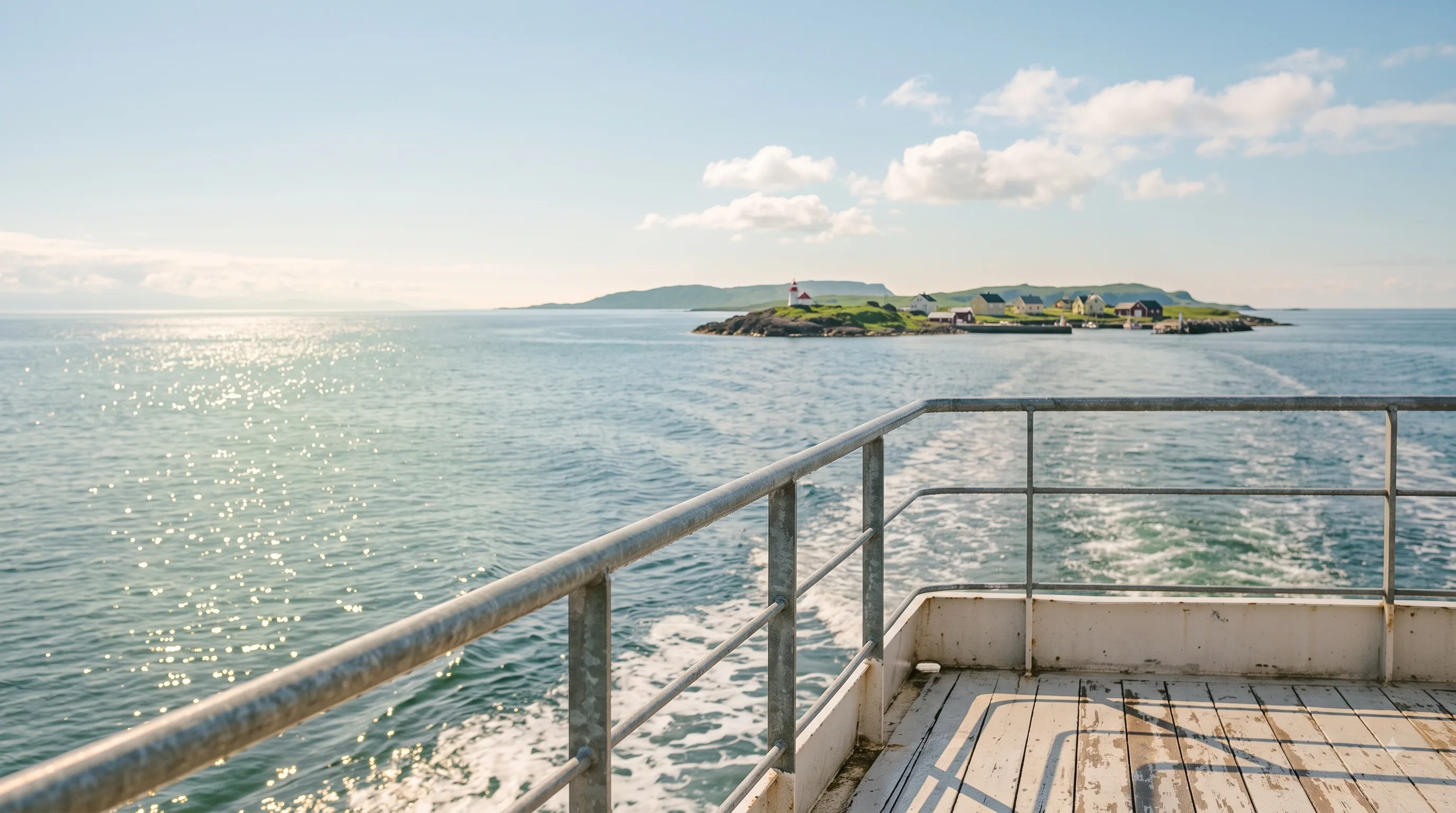
Every ferry crossing has one particular moment: the island you left has slipped behind the wake, the next one is still a smudge in the haze, and for two hours there is nothing to do. That gap is the whole point of island hopping — and it is exactly what disappears the moment you fly.
The harder question is where in Europe this actually works. Islands off a coastline are not the same thing as a way of getting from one to the next.
A note on accuracy: Crossing times, schedules and emissions figures were checked on 11 August 2026. Ferry timetables are seasonal and summer and winter service differ substantially – check the current position before booking.
What island hopping actually needs
Island hopping is not an island holiday. It needs a network rather than a single line: sailings that link island to island, not only island to mainland. Where that is missing, hopping turns into commuting — back to the same port every time, over the same stretch of water.
The distinction sounds academic and decides the trip. A hub-and-spoke network doubles your time afloat and ties you to a mainland base. A chain lets you move on in the morning and arrive somewhere else by evening, travelling light and never doubling back.
A ferry is not automatically the clean option
Before the regions, a figure that rarely makes it into travel writing. The UK government publishes annual conversion factors that cover ferries; Germany’s Federal Environment Agency does not — in its passenger comparison, shipping appears only under freight.
| Mode | g CO₂e/pkm |
|---|---|
| Ferry, foot passenger | 19 |
| Rail (long distance) | 26 |
| Coach | 30 |
| Ferry, with a car on board | 129 |
| Car | 164 |
| Aircraft (domestic) | 290 |
Ferry values come from the UK 2025 conversion factors, the rest from the German Federal Environment Agency (reference year 2024). The two methodologies are not identical, but the orders of magnitude hold.
The decisive jump happens inside the ferry itself. Bringing a car makes the crossing roughly seven times more emissions-intensive per person than walking on — which puts it close to simply driving. Island hopping without flying is the better choice only if the car stays at home. On car-free islands that is not a sacrifice; it is the only option anyway.
North Sea: car-free — and still no hopping
Five of Germany’s seven East Frisian Islands ban cars outright: Juist, Baltrum, Langeoog, Spiekeroog and Wangerooge. Luggage moves by horse cart or narrow-gauge railway, everything else happens on foot or by bike. For anyone who wants to slow down, this is the most consistent place in the country.
What does not exist here is island hopping in the literal sense. There are no scheduled ferries between the islands. Each one hangs off its own mainland port — Norddeich for Juist and Norderney, Neßmersiel for Baltrum, Bensersiel for Langeoog, Neuharlingersiel for Spiekeroog, Harlesiel for Wangerooge, Emden for Borkum. Seeing two islands means going back to the coast in between. What tour operators sell as “island hopping in East Frisia” is a coach tour with several crossings, not a run along a chain. Seasonal excursion boats exist, but they are not a timetable you can build a trip on.
Then there is the tide. Sailings to Wangerooge, Spiekeroog, Baltrum and Juist depend on it — departures shift daily and there is no fixed frequency. Norderney and Borkum run largely independently of the water level. If you are arriving by train, that matters: your connection here answers to the tide table, not the rail timetable. For picking the season, our climate table for popular destinations is the better starting point.
Baltic: the short crossings
Further north things get simpler. Ærø is served by four ferries from Svendborg, Faaborg and Als, up to twenty times a day, with crossings of 55 to 75 minutes. Bornholm is 80 minutes from Ystad with up to sixteen daily departures; 3 hours 20 from Sassnitz, 5 hours 30 from Køge.
What makes the Baltic work is not network density but the approach. Ystad and Svendborg are a single day’s rail journey from Hamburg or Copenhagen, and Sassnitz is reachable on German regional services alone — the monthly Deutschlandticket, now €63, carries you all the way to the quay, which also makes this a realistic short break. Nowhere else in Europe do train and boat mesh this cleanly.
Further east, the Stockholm archipelago counts around 30,000 islands, skerries and rocks, roughly a thousand of them inhabited. The archipelago operator has been running since 1869 and calls at more than 200 landing stages — island hopping at commuter frequency, winter timetable included.
Dalmatia: the densest network
Croatia is where island hopping works without any workaround. The state ferry company runs 57 vessels — twelve catamarans, four conventional ferries, 41 ro-ro units — across 39 regional lines. The Split district alone accounts for thirteen, Zadar for twelve, Rijeka for nine.
In practice: Split–Brač–Hvar–Korčula–Dubrovnik can be run as a chain, catamarans for the fast legs, car ferries for the slow ones. You move on in the morning and arrive by midday, without ever returning to where you started.
The approach is the price. Without flying, the route runs via Munich or Vienna to Zagreb and onward to Split — about a day and a half, part of it on a night train. If you count the crossings as part of the holiday rather than as transfer time, the arithmetic works. If you just want to arrive, it will grate.
Cyclades: the honest long haul
The Greek network is dense. From Piraeus, Paros is about 4½ hours away, Naxos a little over 5, Santorini just under 8. Between islands the legs are short — Naxos to Paros runs year-round in roughly 45 minutes, Santorini to Naxos takes 1½ to 2½ hours depending on the vessel.
Getting there is the problem. Without a plane it means rail to Ancona or Bari, then around 22 hours by sea to Patras, then onward to Piraeus, then the island ferry. Three days each way is realistic. That is not an argument against the route — for many people the Adriatic crossing is the best part — but it is an argument against doing it in a fortnight. Under three weeks it barely pays, and in high summer the heat becomes its own consideration.
The four regions side by side
| Region | Approach without flying | Network | Island to island? |
|---|---|---|---|
| North Sea | half a day | hub and spoke | no |
| Baltic | 1 day | hub and spoke, dense | limited |
| Dalmatia | 1½ days | chain, 39 lines | yes |
| Cyclades | ~3 days | chain, very dense | yes |
The way we see it:
If this is your first attempt at hopping without flying, start in Dalmatia. The network holds up, the legs are short enough to change plans on the day, and a day and a half of travel is still manageable.
The Baltic suits anyone short on time — quick to reach, dependable timetables, no tide arithmetic. The North Sea is the wrong place to hop and the right place to pick one car-free island and stay a week. And the Cyclades repay the overland journey only if you genuinely have the weeks to spend.
In short
- A ferry only saves emissions without a car. Roughly 19 g CO₂e per passenger-kilometre on foot, about 129 with a car aboard — a factor of seven.
- There are no island-to-island ferries in the North Sea. Each island has its own mainland port; “island hopping” there is a tour by land.
- The tide beats the timetable. Wangerooge, Spiekeroog, Baltrum and Juist sail by water level, and departures shift every day.
- Baltic for short notice, Dalmatia for real hopping. Ærø and Bornholm are a day away, Dalmatia a day and a half.
- Greece without flying is a three-week project. Around three days each way, 22 hours of it on the Adriatic.