Travel Trends
Dry Tripping: How an Alcohol-Free Holiday Works
Contents8 sections
- What dry tripping is — and what it is not
- Why on holiday, of all places
- How to recognise alcohol-free stays and retreats
- Daily structure without an aperitif: movement, water, evenings
- Destinations with a strong alcohol-free culture
- Travel companions and groups
- Checklist before booking
- Is a holiday without alcohol right for you?
The first evening at a holiday destination runs the same way almost everywhere: arrive, unpack, a glass on the terrace. The glass is so taken for granted that hardly anyone asks whether it has to be there. In a survey by a large travel company with 20,000 participants, around half showed interest in hotels with easily accessible alcohol-free drinks.[2] An alcohol-free holiday is therefore no longer a fringe idea but a way of travelling with its own demand. What is usually missing is not the will, but a plan for the evenings.
What dry tripping is — and what it is not
Dry tripping means a holiday on which you deliberately drink little or no alcohol. The term appears as a travel trend in its own right in the Expedia Group trend report; the category comes from the Hotels.com brand and describes low-alcohol to alcohol-free travel.[1] Whether other travel associations use the term is not documented — so far the name belongs to a single company. For you as a traveller, that does not matter. The practice is older than the label.
Two distinctions matter. First: dry tripping is not therapy and does not replace it. This article is written for people without a history of addiction who simply want to leave alcohol out of their holiday. If you notice that going without is hard, you will find better help at a counselling service than in a wellness hotel.
Second: it is not a health programme with a guaranteed result. The German Centre for Addiction Issues (DHS) advises every adult to cut down, regardless of how much they drink.[9] That is general advice, not a promise for two weeks by the sea. What an alcohol-free holiday actually changes depends on you, not on the concept.
Why on holiday, of all places
A holiday is where habits tip easily — in both directions. At home you may only drink at the weekend. By the pool, the weekend becomes a week. That is exactly why a holiday is also where going without is easiest to test: the routine is already interrupted.
The data on alcohol consumption in the German-speaking countries supports the trend, but not across the board. In Germany, regular drinking among 18- to 25-year-olds is at its lowest level since measurement began, according to the Federal Centre for Health Education (BZgA).[4] At the same time, binge drinking in the same age group has returned to its pre-pandemic level.[4] Hospital cases with purely alcohol-related diagnoses have fallen by almost a third within a decade, according to the Federal Statistical Office, most sharply among teenagers.[5]
In Switzerland, the share of daily drinkers has been falling since the nineties; among 15- to 24-year-olds, daily drinking is very rare, while binge drinking is widespread.[6] In Austria, the share of teenagers with no alcohol experience at all has quadrupled in just under two decades.[7] Still, six in ten drank in the month before the survey.[7] Our reading: people drink less in everyday life, but still on occasions. A holiday is an occasion.
The drinks market follows this movement. Alcohol-free beers and beer mixes have for the first time exceeded a tenth of retail sales, according to the German Brewers’ Association.[10] The association calls them the fastest-growing category in the country.[10] Whether this market drives travel behaviour or merely accompanies it is not documented. Our assessment: above all, it devalues the excuse “there is nothing else anyway”.
On health, just this much: the WHO Regional Office for Europe states that there is no safe level of alcohol.[3] That is no reason to turn a holiday into a cure. It is a reason not to treat the glass as an obligation.
How to recognise alcohol-free stays and retreats
Do not look for a place that advertises itself as “alcohol-free”. Look for places that make it easy to get by without alcohol — and learn to spot those that make it hard. The differences show before you book, if you know where to look.
| Signal | What it tells you | How to check |
|---|---|---|
| Drinks menu available online | Alcohol-free options beyond cola and water are a sign | Find the menu on the website or request it |
| Half board with drinks package | If the package is built around wine and beer, you pay for abstaining | Ask whether a package without alcohol is available |
| Evening programme | Bar nights and happy hour set the tone for the whole evening | Request the weekly programme, look for alternatives |
| Location near spa, baths, hills | Movement and water structure the day, not the bar | Check distance and walking access |
| Retreat with a daily schedule | A fixed rhythm of classes and rest leaves no gap for alcohol | Request a sample day, look at the evening slots |
| Language of the description | ”Indulgence”, “wine cellar”, “sundowner” reveal what the place emphasises | Scan the website and reviews for these terms |
(The table lists six signals, what they say about a property’s alcohol culture, and how to check them before booking.)
None of these signals is decisive on its own. A place with a wine cellar can still be a good choice if there is enough to do during the day and nobody tops up your glass in the evening. Conversely, the best alcohol-free selection is no use if the only meeting point is the bar.
Retreats with a fixed programme are often the easier choice for a first attempt, because they plan the evenings for you. How that works for silence and digital-detox formats is described in Silent Travel: Digital Detox and Silence Retreats. Much of it transfers to an alcohol-free holiday: structure replaces decision.
Daily structure without an aperitif: movement, water, evenings
The problem with an alcohol-free holiday is not the morning. It is the hour between coming back and dinner — the hour that used to hold the aperitif. If you do not fill that gap, you fill it with the familiar. So you plan it first.
What works varies. One pattern we recommend, because it plans the day from the evening:
- Put the most strenuous activity in the late afternoon. Anyone returning from a hike at six wants water, not wine.
- Book dinner early and long. A multi-course meal carries an evening better than a quick plate followed by emptiness.
- Plan something with a beginning and an end for after dinner: a performance, a night swim, a walk through the old town.
- Drink something that tastes of something. Alcohol-free beer, bitter lemonade, tea — the point is a glass in your hand that you chose.
- Go to bed earlier than you otherwise would on holiday. Days without alcohol start earlier because they end when the evening is done.
Whether you sleep better by going without cannot be objectively proven. A cohort study at the University of Sussex compared Dry January participants with a comparison group over seven months.[8] Those who completed the month reported better wellbeing and more control over their own drinking; these effects lasted into the summer.[8] All values are based on self-reports, not measurements; participants had signed up themselves.[8] For a holiday this means: expect nothing measurable, but count on evenings that end differently.
If you are unsure whether it will hold for two weeks, test it over two days. The article Short Breaks and Weekend Trips explains what a short time away delivers and what it does not — an alcohol-free weekend is the smallest meaningful trial.
Destinations with a strong alcohol-free culture
There is no map of alcohol-free regions, and destinations do not advertise that way. There are, however, three types of landscape where a day without alcohol needs less planning because the place already structures it.
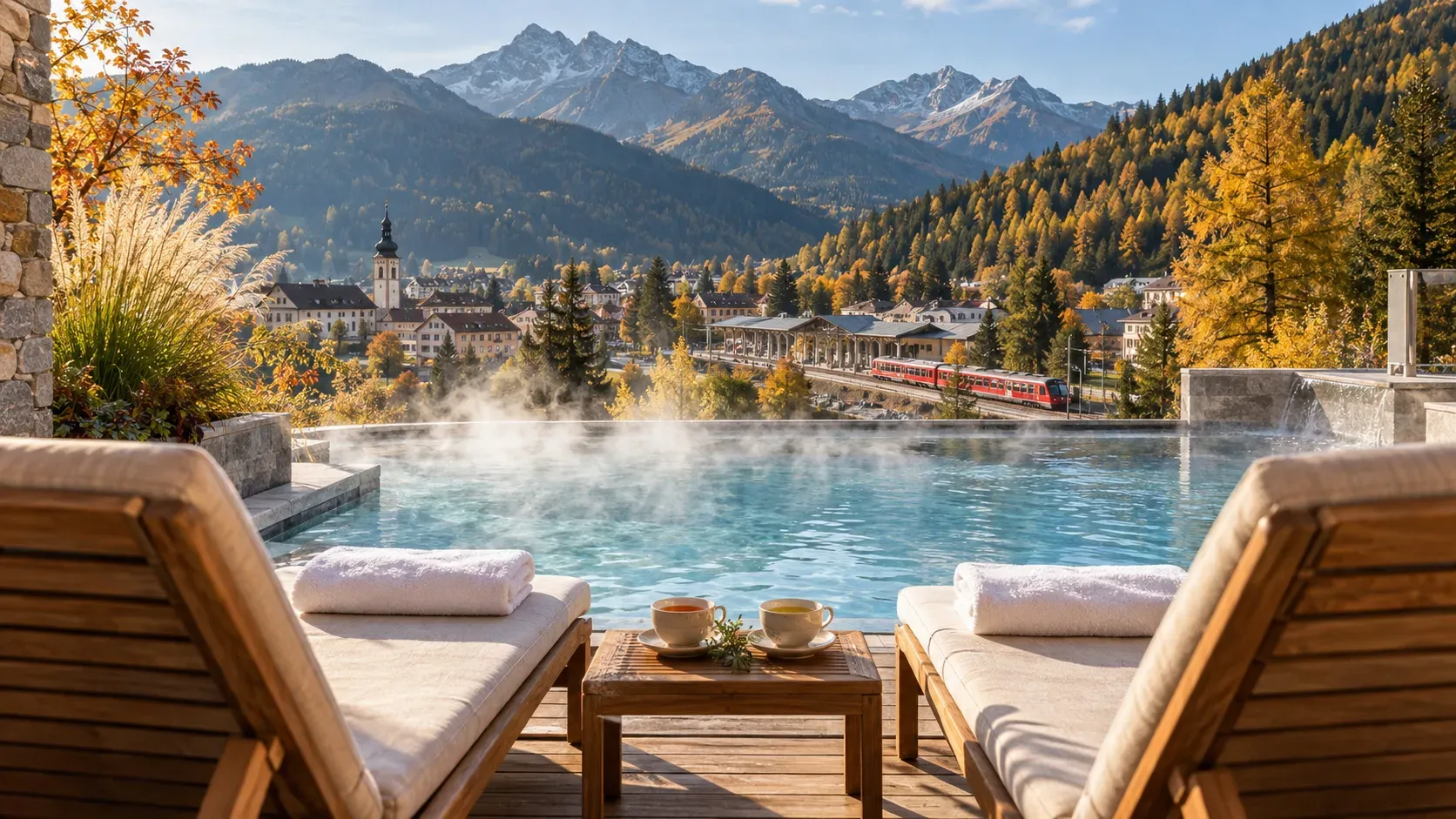
Thermal spas and spa towns: the day follows the pools, not the bar. Anyone lying in warm water in the afternoon rarely feels the need for a second high in the evening. When the baths close, dinner becomes the end of the day, not the start of the night.
Mountains: altitude makes the aperitif unattractive. After the climb, the body wants water and salt, and the next day starts early. Mountain huts are not alcohol-free places, but the evenings there are short.
Coast out of season: beach bars live off the sundowner. Without the bar, the coast is a place for long walks, cold swims and early nights. Travelling in the off-season, you meet fewer drinkers and more walkers.
This mapping is our assessment from experience, not a documented rule. A spa hotel with a wine evening remains a spa hotel with a wine evening. The landscape helps; it does not decide.
Travel companions and groups
A weighty reason to drink on holiday after all sits at the same table. Not out of malice, but out of habit: whoever orders, orders for everyone. Three situations come up almost every time, and each has a solution that lectures no one.
As a couple, the other drinks: say it before the trip, not on the first evening. One sentence is enough — “I am leaving out alcohol this time, order whatever you like.” No justification, no request for consideration. A justification invites discussion; a sentence does not.
In a group: take over planning the evenings. Whoever reserves the table, books the tour and proposes the programme decides where the evening takes place. A group sitting in a restaurant at eight and on the beach at ten has less bar time than one that says “let’s see”.
Alone: easy, because nobody tops up your glass — and hard, because nobody is there when the evening goes empty. Solo travellers therefore plan the evenings even more firmly. What helps, and what solo travellers over 40 do differently, is covered in Solo Travel from 40 and 50.
Expect to be asked. “Why aren’t you drinking?” is a question that comes, and one with a short answer: “Not this time.” Anyone who asks again gets the same answer again. Justification produces discussion; a short sentence ends it.
Checklist before booking
- Request the property’s drinks menu and check whether there is more than water and soft drinks without alcohol.
- Ask whether half board or all-inclusive can be booked without an alcohol package.
- Read the weekly programme and mark every evening that leads to a bar or tasting.
- Check the walking distance to spa, baths, hiking trails or beach.
- Tell your travel companions before booking that you are travelling without alcohol.
- Plan an activity with a fixed end for every evening before you book the outbound flight.
- Pack a favourite alcohol-free drink in case the menu on site disappoints.
- Book two to three nights for the first attempt, not two weeks.
Is a holiday without alcohol right for you?
If your holiday evenings have so far consisted mainly of glasses, the answer is yes. Not for health reasons, but because otherwise you will never find out what an evening at a destination without a glass is like. The demand exists, the range of drinks is growing,[10] and a place that makes it easy for you can be recognised before booking. Start with a weekend. If it holds, you know what the two weeks will look like.


References
[1]: Introducing Unpack ‘24: The Trends in Travel from Expedia, Hotels.com and Vrbo (opens in a new tab) – travel company press release, published: 08.11.2023
[2]: Unpack ‘24: Hotel Trends – Expedia Group Partner Blog (opens in a new tab) – travel company market research, published: 28.02.2024
[3]: No level of alcohol consumption is safe for our health – WHO Regional Office for Europe (opens in a new tab) – health authority, published: 04.01.2023
[4]: BZgA: Alcohol consumption among young people – results of the 2023 survey (reproduced by Deutscher Präventionstag) (opens in a new tab) – health authority, secondary publication, published: 04.11.2024
[5]: Federal Statistical Office: Inpatient cases due to alcohol-related diagnoses (opens in a new tab) – official statistics, published: 11.02.2026
[6]: Sucht Schweiz: Facts and figures on alcohol consumption (opens in a new tab) – addiction agency, accessed: 11.09.2026
[7]: Gesundheit Österreich GmbH: Substance use among adolescents – ESPAD survey 2024 (opens in a new tab) – federal research institute, published: 2024, accessed: 11.09.2026
[8]: de Visser & Piper: Short- and Longer-Term Benefits of Temporary Alcohol Abstinence During ‘Dry January’ – Alcohol and Alcoholism (opens in a new tab) – peer-reviewed journal, published: 07.2020
[9]: DHS Scientific Board: Recommendations on dealing with alcohol (opens in a new tab) – professional association, position paper, published: 10.2023
[10]: German Brewers’ Association: Alcohol-free beers climb to 10 percent (opens in a new tab) – industry association press release, published: 02.02.2026