Travel Trends
Wellness Weekend for Two: What 48 Hours Can Really Do
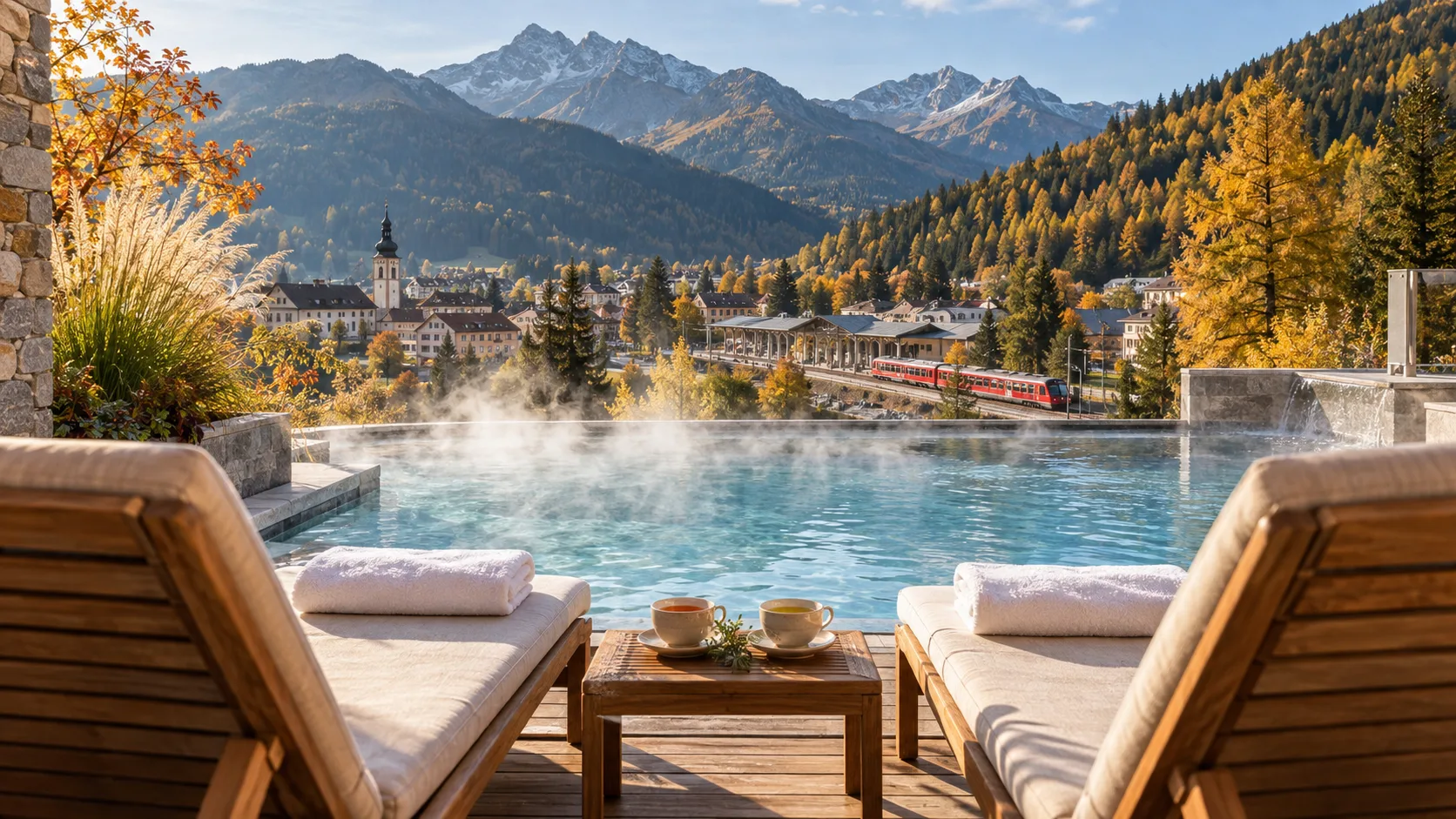
Contents8 sections
- Why a weekend for two works differently from a solo retreat
- Wellness hotel, spa town, day spa — which format suits which couple
- Terms without marketing: spa, wellness hotel, Heilbad, Kurort
- The 48-hour rhythm: arrival, rest, treatment, wind-down
- Without a car: wellness regions in the DACH countries with rail access
- Phone, silence, conversation — agreeing rules as a couple
- Typical mistakes: too many treatments, too little rest, the wrong season
- Conclusion
Friday arrival, Saturday three treatments and a sauna programme, Sunday departure with the feeling of having completed a compulsory routine. That is what a wellness weekend often looks like when two people with different expectations book the same package. One wants quiet, the other wants to do something, and the hotel has both in its brochure. The problem is rarely the hotel. It is that nobody said beforehand what these 48 hours are supposed to deliver.
Why a weekend for two works differently from a solo retreat
Alone in a spa, you only have to negotiate with yourself. As a couple, a second expectation comes along, and it is usually unspoken. That is exactly what the return on the weekend depends on.
Relationship research offers a useful pointer here. A series of studies from consumer research shows that couples who keep shared rituals report more positive emotions, higher relationship satisfaction and stronger commitment than couples without them. The effect only appears, however, when both partners see the same activity as a meaningful ritual rather than a mere routine.[11] For a spa weekend, this means the shared sauna session works differently when both want it than when one drags the other along.
The second point concerns switching off. A review article on the mobile working world summarises that constant availability during leisure time and blurred boundaries between work and private life can impair mental detachment. Those who do not switch off tend to sleep worse and feel more exhausted.[10] As a couple, this matters twice over. If one of you reads emails at the poolside, the other is on holiday alone.
Together, these two points define the real task: not planning the programme, but the shared framework.
Wellness hotel, spa town, day spa — which format suits which couple
Three formats are on offer, and they differ less in what they provide than in the question of who sets the pace.
| Format | Who sets the pace | Suits you if you … |
|---|---|---|
| Wellness hotel with inclusive spa | you do — the spa belongs to the house | want no journeys and prefer to structure the day yourselves |
| Spa town with a public thermal bath | the bath does — opening windows, crowds, distances | enjoy moving around a town and do not need the bath to yourselves |
| Day spa in the city | the appointment does — treatment at the core, stay optional | are looking for one ritual rather than a whole weekend of spa |
(The table compares the three formats by who sets the daily pace and which expectation each one suits.)
What a hotel spa must offer structurally is surprisingly clearly defined. The German hotel classification lists wellness and beauty as an area with point criteria: massages, relaxation room, sauna, bathing department, private spa cabin, pools. The footnotes require that this area can be reached without walking through the restaurant or conference area, and they specify minimum sizes for treatment and relaxation rooms.[4] Important for your expectations: these criteria are optional point criteria, not a minimum standard of any star category. A four-star hotel does not have to have a relaxation room; it only earns points if it has one.[4]
For the everyday rules — nudity in the sauna, age limits, quiet zones, access for day guests — our research found no association standard that makes the three formats comparable. This is a limit of the evidence, not a side note: these rules differ from one establishment to the next, and you are best off clarifying them with the house before booking. How to recognise a hotel that genuinely works for two nights is covered in our separate article on choosing a hotel for two nights.
Terms without marketing: spa, wellness hotel, Heilbad, Kurort
Four terms appear on every booking page, and only two of them mean anything binding.
Heilbad, Kurort, Luftkurort, Erholungsort (health resort, spa resort, climatic resort, recreation resort) are official designations in Germany. The definitions of the German Spa Association, published jointly with the German Tourism Association, have largely been incorporated into the spa resort laws and regulations of the federal states.[1] A town does not receive the designation by giving it to itself. In Bavaria, for example, the Ministry of the Interior decides in agreement with other ministries on the recommendation of an expert committee, and without an application from the municipality there is no recognition.[2] In Austria, spa matters lie with the federal states; recognition as a Kurort is a ruling by the state government, not a decision by an association.[5][6] In Switzerland the situation is different: the association Heilbäder und Kurhäuser Schweiz is a private trade body whose directory lists only member establishments.[7] What is legally tangible there is the approval of a Heilbad as an establishment eligible for health insurance reimbursement — with medical supervision, a healing spring on site and cantonal approval. That is an operating approval, not a designation for a place.[17] Whether a statutory Kurort designation exists alongside it is something we could not establish.
Wellness hotel and spa, by contrast, are in our assessment free terms. We found no legal or official source that defines the protection status of these two words for Germany, Austria or Switzerland. A law firm article from Austria classifies the word element Wellnesshotel as non-distinctive and therefore freely usable. That is a classification, not proof — treat these terms as advertising, not as a promise of quality.
Orientation comes instead from an association seal. The Deutsches Wellness Zertifikat of the German Wellness Association checks several hundred individual criteria in seven areas, from service quality through facilities and cleanliness to health and environmental protection.[3] A house must reach a minimum share of points in every area, and the seal is valid for a limited period.[3] The assessment follows an application and self-disclosure with an unannounced, anonymous test stay.[3] Stars and wellness seal are two separate systems run by different bodies — that they complement each other is our reading, not a statement by the associations.
The 48-hour rhythm: arrival, rest, treatment, wind-down
What two days away can deliver in general is something we looked at through recovery research in our piece on short breaks and weekend trips. For the spa weekend, an honest caveat applies: we found no robust study on the short-term effects of a single sauna or thermal weekend on sleep and relaxation. The available statements concern regular use. What you feel on Sunday is, in our assessment, a subjective relaxation response, not a measurable health effect.
That makes the rhythm all the more important, because it is the only thing you can control.
Friday — arriving. Book nothing fixed after arrival. The first evening is for settling in: look at the house, find the relaxation room, read the rules, take a first sauna session without time pressure.
Saturday — one core, plenty of margin. One treatment, not three. Around it, time without a clock: lying down, reading, walking. Filling the day with appointments moves work mode into the spa.
Sunday — wind-down, not departure. Check out late if the house offers it, and do not wedge the return journey into the morning. For many, a weekend does not end at check-out but at the first glance at the calendar.
The facts clear two myths out of the way here. That sauna sessions strengthen the immune system or protect against colds is not scientifically proven; a fact check by Cochrane Austria found only two studies, both with serious methodological flaws.[8] And the claim that sweating detoxifies the body is rated as unsupported by a scientific fact-checking portal.[9] Regular sauna use is associated with cardiovascular benefits, but the quantities of pollutants excreted through sweat are biologically insignificant; the actual detoxification is done by the liver and kidneys.[9] Sauna is relaxation, not a substitute for therapy.
Without a car: wellness regions in the DACH countries with rail access
For a weekend without a car, you need two things, both of which can be checked: a place with a binding designation and a railway station in the town. Three examples show the mechanism, but are not a recommendation for any particular house.
Bad Kissingen is one of the five Bavarian state spas and has its own railway station.[12][13] The state spa status appears in the official register separately from the health resorts recognised under state law; how it is to be classified legally remains open after our research. Bad Hofgastein in the state of Salzburg is recognised as a Kurort with its own spa regulations by ordinance of the state government, based on the Salzburg Healing Resources and Spa Resorts Act.[14] The town has a station operated by ÖBB on the Tauern railway.[15] Bad Ragaz in the canton of St. Gallen has a station in the town, from which a local bus runs through the spa centre.[16] We found no official Kurort status for the town; in our assessment the name there has grown historically.
The checking routine for any other place is the same: look up the designation in the federal state’s official register, look up the station with the rail operator, ask the house about the way from the station. Journey times and frequencies change; the status and the station remain.
Phone, silence, conversation — agreeing rules as a couple
The review article on the mobile working world puts the core problem plainly: a lack of mental detachment goes hand in hand with worse sleep, a worse work-life balance and rising exhaustion, and meta-analyses link successful detachment with better sleep quality.[10] As a couple, it is not enough for one of you to switch off. Three agreements made before departure resolve most conflicts:
- Availability: one fixed window a day for phone and emails; outside it, the device stays in the room. If you want the more radical route, you will find it in our piece on Silent Travel, digital detox and silence retreats.
- Silence: the relaxation room and the sauna are not places for conversation. Agree where you talk and where you do not, before another guest’s glance decides it for you.
- Separate time: if one of you wants an hour alone in the pool, say so in advance. A shared weekend does not fail because of separate hours, but because of unspoken expectations.
The ritual that relationship research talks about does not have to be anything big. The walk to the sauna before dinner is enough, as long as both of you see it as a shared ritual and not as an obligation.[11]
Typical mistakes: too many treatments, too little rest, the wrong season
The mistakes repeat themselves, and almost all of them arise before arrival.
- Reading the package as a schedule. Three included treatments are an offer, not a timetable. Use them all and you have three appointments on Saturday.
- Confusing stars with spa quality. The stars rate wellness only through optional points; a relaxation room is not a minimum standard.[4]
- Taking health promises seriously. Immune boosting and detoxification through sauna are not proven.[8][9] If you arrive with a complaint, in our assessment you are better served by a Heilbad with medical supervision than by a wellness hotel.
- Reading the rules only on site. Nudity, age limits and quiet zones are a matter for the establishment. Asking beforehand saves the first argument on Friday evening.
- Underestimating the season. A spa town on a bank holiday weekend is a different place from a weekday in autumn. If you want quiet, choose the low season and midweek, if your calendar allows.
- Wedging the return journey into the morning. Sunday is part of the weekend, not the buffer for the trip home.
To clarify before booking — the checklist for two:
- What should the weekend deliver: rest, experience or both — and for whom?
- Which format fits: a house with its own spa, a spa town or a day spa?
- Does the place carry a designation, and does it have a railway station?
- Which house rules apply to the sauna, relaxation room and day guests?
- When is phone time, and when is it not?
- How many treatments — and how much time without appointments?
Conclusion
A wellness weekend for two succeeds not through the better hotel, but through the clearer agreement. Choose the format according to the rhythm you want, check designation and station rather than brochure and stars, and plan one treatment with plenty of margin rather than three with none. What the 48 hours then deliver is not therapy — but shared time that both of you wanted.


References
[1]: Begriffsbestimmungen – Qualitätsstandards für Heilbäder und Kurorte, Luftkurorte, Erholungsorte (Deutscher Heilbäderverband) (opens in a new tab) – association / designation body, published: 04.11.2023
[2]: Kurorte, Luftkurorte, Erholungsorte (Bavarian State Ministry of the Interior, Sport and Integration) (opens in a new tab) – public authority (state ministry), accessed: 13.09.2026
[3]: Zertifizierung – Deutsches Wellness Zertifikat (Deutscher Wellness Verband) (opens in a new tab) – association, accessed: 13.09.2026
[4]: Kriterienkatalog Deutsche Hotelklassifizierung 2025–2030 (DEHOGA / Hotelstars Union) (opens in a new tab) – trade association / classification system, published: 24.04.2024
[5]: Der Verband (Österreichischer Heilbäder- und Kurorteverband) (opens in a new tab) – association / designation body, accessed: 13.09.2026
[6]: Salzburger Heilvorkommen- und Kurortegesetz 1997 (Austrian Legal Information System RIS) (opens in a new tab) – state law, accessed: 13.09.2026
[7]: Heilbäder und Kurhäuser Schweiz – the association (opens in a new tab) – association, accessed: 13.09.2026
[8]: Stärkt die Sauna das Immunsystem? (medizin-transparent.at, Cochrane Austria) (opens in a new tab) – evidence-based health fact-checking portal, published: 08.04.2025
[9]: Lack of reliable evidence supporting the claim that sauna bathing detoxes the body (Science Feedback) (opens in a new tab) – scientific fact-checking portal, published: 05.09.2024
[10]: Reinke, K. & Düvel, M.: Always Online – Abschalten in einer mobilen Arbeitswelt (Organisationsberatung, Supervision, Coaching) (opens in a new tab) – journal article (review), published: 2022
[11]: Garcia-Rada, X., Sezer, O. & Norton, M. I. (Journal of the Association for Consumer Research 4(2), 185–197) (opens in a new tab) – peer-reviewed journal article, published: 2019
[12]: Official register of spa and recreation resorts in Bavaria (Bavarian State Ministry of the Interior) (opens in a new tab) – public authority, status: 28.08.2025
[13]: Bad Kissingen station (bahnhof.de, Deutsche Bahn) (opens in a new tab) – rail operator, accessed: 13.09.2026
[14]: Kurordnung für Bad Hofgastein (Austrian Legal Information System RIS) (opens in a new tab) – official legal source (state ordinance), LGBl No. 46/2006
[15]: Bad Hofgastein station (ÖBB) (opens in a new tab) – rail operator, accessed: 13.09.2026
[16]: Geography and getting there (municipality of Bad Ragaz) (opens in a new tab) – municipality, accessed: 13.09.2026
[17]: Badekuren (Federal Office of Public Health FOPH) (opens in a new tab) – federal authority, accessed: 13.09.2026