Accommodation
Wellness Hotels: How to Spot One That Really Delivers
Contents7 sections
- What makes a wellness hotel – and what is just a label
- Spa types: thermal spa hotel, medical wellness, adults-only, nature hotel
- Quality seals and classifications: what they check and what they do not
- How to spot a good hotel before you book
- Wellness holiday or wellness weekend: what research says about length
- Thermal spa towns in Germany, Austria and Switzerland: how designations are awarded
- Conclusion
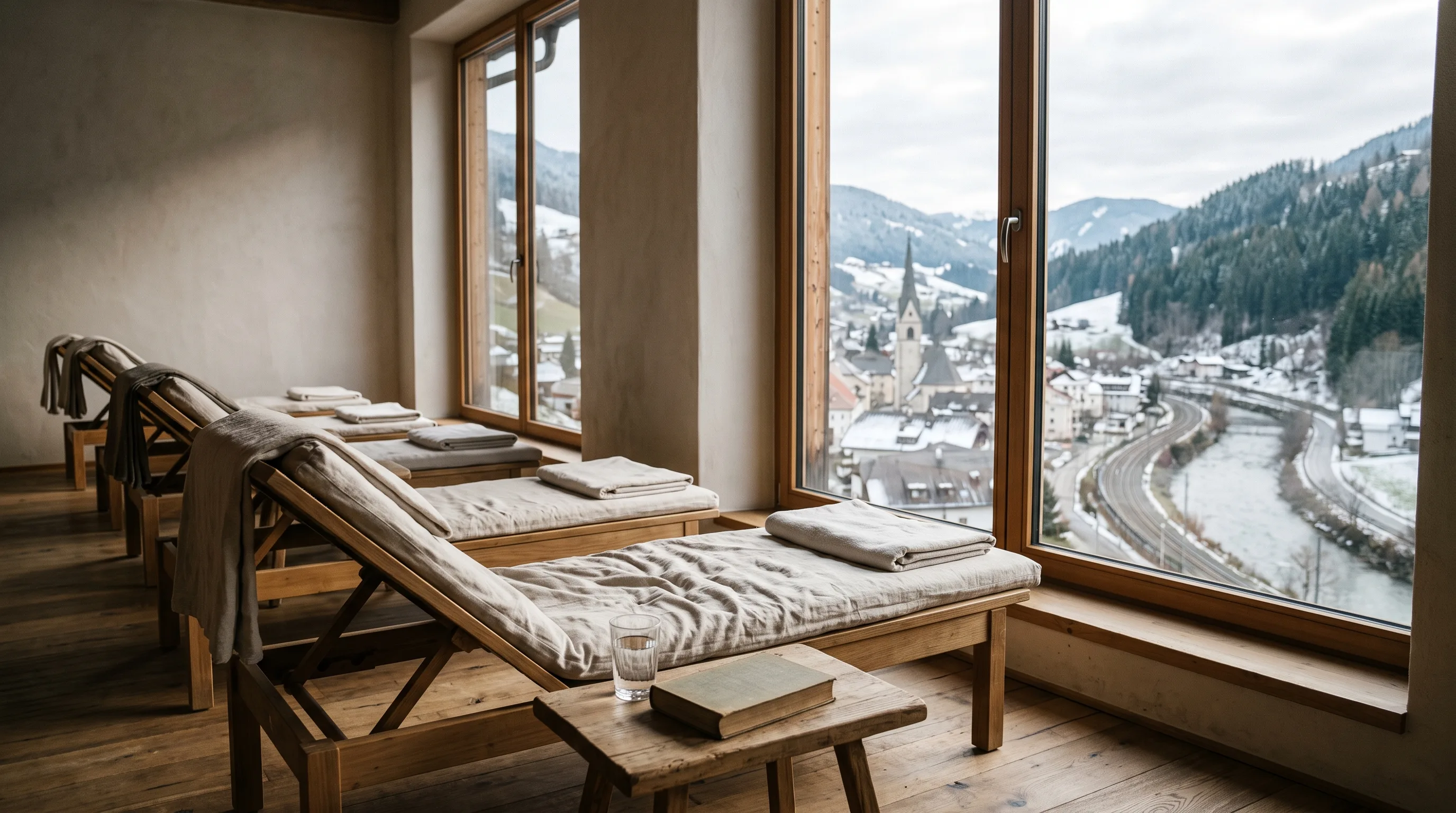
A hotel with eighty rooms, one sauna and eight loungers in the relaxation room calls itself a wellness hotel. By Saturday afternoon you notice what that means: towels reserving loungers, a queue for the sauna, chatter in the quiet room. The star rating has no hotel category called wellness hotel.[1] Whether a hotel lets you rest depends on a few features, and you can check most of them before you book.
What makes a wellness hotel – and what is just a label
In the Hotelstars Union classification, which also applies in Germany, Austria and Switzerland, wellness is one block of criteria among many.[1] A hotel collects points there, for example for different sauna types or a relaxation room of at least 20 square metres. Treatment rooms of at least 10 square metres also count.[1] No separate wellness class results from this, and the block says nothing about staff or hygiene.[1]
So the number of stars alone does not tell you whether a hotel earned its points in the spa.
We also found no legal definition of the term wellness hotel in Germany, Austria or Switzerland. The industry itself was more precise.
Two industry bodies published a definition of “Wellness-Hotel” with three levels (W, WW and WWW). They are the German Hotel Association (IHA) and the German Hotel and Restaurant Association (DEHOGA Bundesverband).[2] A hotel needs at least three stars, and the checks cover location, cuisine, advice and the spa area, among other things.[2] Whether this catalogue is still applied today is not documented.
Its numbers still help you compare hotels.
Spa types: thermal spa hotel, medical wellness, adults-only, nature hotel
Four more labels appear in hotel descriptions. The Hotelstars Union criteria catalogue defines none of them.[1] For medical wellness, adults-only and nature hotel, we could not document an association definition or a legal basis either.
| Label | What can be documented | What to ask |
|---|---|---|
| Thermal spa hotel | Thermal water is 20 °C or warmer where it leaves the spring[3] | Where does the water come from, and does it feed the hotel’s pools? |
| Medical wellness | no binding definition found | Who gives the treatments, and with what training? |
| Adults-only | no binding definition found | Does the age limit apply to the whole hotel or only the spa? |
| Nature hotel | no binding definition found | What exactly is close to nature: location, building, cuisine? |
(The table shows four labels, what can be documented about them and one question to check each before booking.)
With a thermal spa hotel, take a second look. Designations such as thermal spa town apply to towns or parts of towns, not to individual hotels.[3] The designation tells you something about the town. It does not tell you which water flows into a particular hotel’s pools.
For a hotel without a bar scene, Dry Tripping: How an Alcohol-Free Holiday Works will help.
Quality seals and classifications: what they check and what they do not
Besides stars, hotels also advertise with wellness seals. Stiftung Warentest examined 53 of them and rated only nine as helpful.[4] Most of these nine work with fixed requirements and inspect the hotels on site at regular intervals.[4] The test singles out the hotel certificate of the German Wellness Association, which requires offers for relaxation, fitness and healthy eating.[4]
For the large remainder, the testers criticised three things. Issuers set their own standards, ask little of staff and facilities and hardly verify what applicants tell them.[4] The rating considered the scope of the criteria, checks such as on-site inspections and the issuers’ transparency.[5] The test is older; criteria, providers and inspection procedures may have changed since.
You can still ask every seal two questions:
- Does the issuer disclose its criteria and inspection procedure?
- Does someone inspect on site, or is a self-declaration enough?
How to spot a good hotel before you book
The IHA and DEHOGA association catalogue gives ratios for the spa area.[2] With them you can read floor plan, photos and room count against each other.
| Feature | Level W | Level WWW |
|---|---|---|
| Indoor loungers | 20 % of room count, at least 15 | 40 % of room count, at least 40 |
| Indoor saunas | 1, at least 6 seats | 3, at least 10 seats |
| Treatment rooms of 10 m² or more | 4 % of rooms, at least 3 | 6 % of rooms, at least 6 |
| Treatment rooms with daylight | 50 % | 75 % |
(The table compares the minimum values of the lowest and the highest level of the association catalogue.)
According to the catalogue, one more sauna seat is added per ten rooms.[2] Back to the hotel with eighty rooms: even the lowest level requires 16 loungers, the highest 40.[2] Eight loungers are exactly half the entry value. Only professionally trained staff should give treatments, and hygiene is checked continuously.[2]
Hygiene rules apply regardless of seals. In Germany, pools in hotels fall under the Infection Protection Act. The operator is responsible and the local health authority supervises.[6] In Switzerland, hotels with a steam bath or whirlpool must name a responsible person and record their checks in writing.[8]
In Austria, the Bath Hygiene Act covers pools, saunas and steam baths and places them under the health authority’s inspection.[7] For the sauna, a person with hygiene expertise must be reachable during operation.[7]
How to check a hotel before booking:
- Ask for the number of loungers and divide it by the number of rooms.
- Count saunas and sauna types on the spa plan, not in the advertising photo.
- Check whether you can reach the spa from your room without crossing the restaurant or conference area.[1]
- Ask who gives the treatments and what training they have.
- For every seal, check whether criteria and inspection procedure are public.
- Read reviews specifically for weekends if you are arriving on a weekend.
Many of these questions apply to any hotel. More criteria for short stays are in How to Spot a Hotel That Works for Two Nights.
Wellness holiday or wellness weekend: what research says about length
The obvious assumption is that a week restores you more than two nights. Research does not support it. A meta-analysis of 13 studies found that holidays improve well-being, but not life satisfaction.[9] The length of the holidays studied, between 4 and 23 days, did not change these effects.[9]
From the first week back at work, well-being no longer differed significantly from the pre-holiday level.[9] An older meta-analysis reached a similar picture: a small effect that fades quickly after returning to work.[10] The authors of the newer analysis therefore recommend regular short holidays spread over the year.[9]
Two limits belong to this. The analysis does not cover stays of under four days, so a direct comparison with a weekend is missing. We found no evidence on whether the results carry over to wellness holidays.
According to this research, a longer stay is no guarantee of rest. If you only have two nights, you plan them differently from a week. Wellness Weekend for Two: What 48 Hours Can Really Do describes how.
Thermal spa towns in Germany, Austria and Switzerland: how designations are awarded
If you want genuine thermal water, look at the town, not the hotel. In Germany, spa town designations follow definitions issued by the German Spa Association and the German Tourism Association.[3] A mineral or thermal spa town needs a medicinal spring, reports on climate and air and a spa or bath doctor. It also needs facilities such as a treatment centre and spa park.[3]
In Baden-Württemberg, a spa towns act governs recognition. It names thermal spa town as a separate type and only recognises municipalities or parts of them on application, not hotels.[11] In the Austrian state of Salzburg, the state government recognises spa towns by official decision. Requirements include a medicinal resource on site and spa facilities.[12]
In Switzerland, a federal ordinance sets out when a spa is approved. It requires medical supervision, use of a medicinal spring on site, qualified staff and approval under cantonal law.[13] Exceptions to the spring requirement are possible.[13]
You find a town’s designation in the register of the respective state. If you want to travel by rail, check the station separately in the timetable search.
Conclusion
The name says little; ratios from the association catalogue say more: loungers per room, sauna seats, treatment rooms with daylight.[2] With seals, check whether the issuer discloses how it inspects and whether it inspects on site.[5] More nights did not increase the recovery effect in research.[9] Before your next booking, ask how many loungers there are.
References
[1]: Kriterienkatalog Deutsche Hotelklassifizierung 2025–2030 (Hotelstars Union) (opens in a new tab) – classification body, criteria catalogue, published: 13.11.2025
[2]: Verbandskriterien „Wellness-Hotel“ (German Hotel Association IHA and DEHOGA federal association) (opens in a new tab) – association, criteria catalogue, published: August 2005
[3]: Begriffsbestimmungen/Qualitätsstandards für Heilbäder und Kurorte, 14th edition (German Spa Association, German Tourism Association) (opens in a new tab) – association standard, published: 04.11.2023
[4]: Wellness-Siegel: Nur 9 von 53 sind hilfreich (Stiftung Warentest) (opens in a new tab) – consumer test, press release, published: 26.09.2013
[5]: Wenig hilfreiche Gütesiegel für Wellness und Medical Wellness (Stiftung Warentest) (opens in a new tab) – consumer test, test table, retrieved: 12.10.2026
[6]: Hygieneanforderungen an Bäder und deren Überwachung (German Environment Agency, Bundesgesundheitsblatt) (opens in a new tab) – authority, official recommendation, retrieved: 12.10.2026
[7]: Infoblatt Bäder, Sauna- und Dampfbäder (Vienna Chamber of Commerce) (opens in a new tab) – business association, information sheet, retrieved: 12.10.2026
[8]: Merkblatt Duschanlagen und Bäder: Legionellen (Canton of Zurich) (opens in a new tab) – authority (cantonal enforcement), information sheet, valid from: 31.10.2025
[9]: Speth, Wendsche, Wegge: We continue to recover through vacation (European Psychologist) (opens in a new tab) – peer-reviewed meta-analysis, published: 01.10.2023
[10]: de Bloom et al.: Do we recover from vacation? (Journal of Occupational Health) (opens in a new tab) – peer-reviewed meta-analysis, published: 11.02.2009
[11]: Kurortegesetz Baden-Württemberg (umwelt-online) (opens in a new tab) – state law, reproduction, published: 31.07.2019
[12]: Salzburger Heilvorkommen- und Kurortegesetz 1997 (FAOLEX) (opens in a new tab) – state law, reproduction, retrieved: 12.10.2026
[13]: Verordnung über die Krankenversicherung (KVV), Art. 57 (Fedlex) (opens in a new tab) – federal law, ordinance text, version of: 01.07.2026