Travel Trends
Silent Travel 2026: Digital Detox & Silence Retreats
Contents6 sections
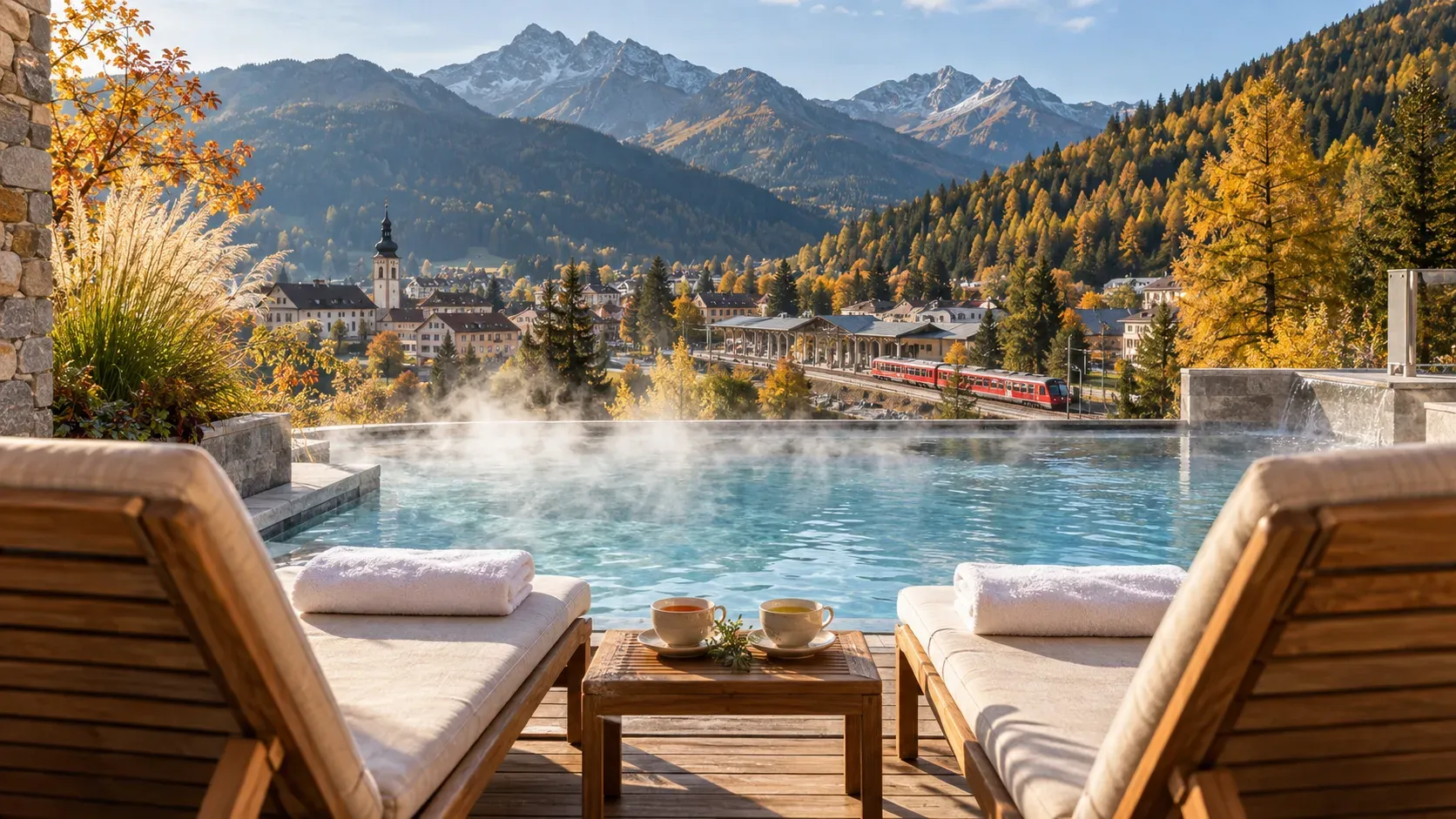
When were you last truly quiet – no notification, no background noise, no sense of having to be reachable? For many people that has become the real luxury. Silent travel turns it into a reason to go: deliberately seek out the quiet, go offline and escape the constant hum of everyday life. For sustainability-minded travellers from Central Europe it fits slow travel perfectly – and often begins with a calm train ride rather than a hectic day of flying.
A quick word on accuracy: The noise and usage figures here come from official surveys (European Environment Agency, WHO, the German Environment Agency) and from representative Bitkom polls; the prices were checked directly on the providers’ own pages in August 2026 – they change and serve only as an order of magnitude. On the effects of silent travel, by contrast, there is very little solid research: as set out openly below, not a single study on the phone-free holiday exists to date. “Digital detox” and “silent” are also not protected terms – not every offer advertised this way delivers on its promise.
Why quiet is becoming a luxury
Quiet has become measurably scarce in Europe. According to Environmental noise in Europe 2025 by the European Environment Agency (EEA), around 112 million people – more than one in five – live permanently with noise above the EU reporting threshold of 55 decibels. Apply the stricter WHO recommendations and the figure is roughly 150 million. The agency now ranks traffic noise as the continent’s third-largest environmental health risk, behind air pollution and heat: some 1.5 million healthy life years lost and 73,000 premature deaths a year.
The benchmark is stricter than policy sets it. Since 2018 the WHO has recommended staying below 53 decibels for road traffic – the EU only starts reporting at 55. In Germany, a representative 2024 survey by the German Environment Agency (2,552 respondents) found 67 per cent are bothered by road traffic noise where they live.
Then there is the noise we make ourselves. By their own estimate, people in Germany used their smartphone for around 180 minutes a day in 2026, according to Bitkom – up from roughly 150 in 2024. And a holiday barely protects you: 66 per cent of employed people stay reachable for work during their summer break, yet only 16 per cent of them do so of their own accord. For 53 per cent it is colleagues who expect it.
The odd part: the will to push back is shrinking while screen time grows. In 2024, 41 per cent of Germans planned a digital fast, in 2025 it was 36, for 2026 only 27 per cent – and for an average of just three days. Silent travel steps into exactly that gap: what fails in daily life is supposed to be forced by the trip.
Forms of silent travel
Quiet can be travelled in very different ways – from gentle to radical, and with price tags that lie surprisingly far apart.
Digital detox – deliberately offline
The lowest-threshold variant: deliberately putting the smartphone away. It becomes substantial where the infrastructure simply doesn’t exist. Hotel Rosenlaui in the Bernese Oberland, for instance, has neither television nor radio nor an internet connection in its Belle Époque houses, and only limited mobile reception; Hotel Simmenfälle at Lenk does without Wi-Fi entirely and asks guests to switch every device to flight mode. (Its reasoning about being “radiation-free” is not medically established – what holds up is the plain promise that no Wi-Fi is running.)
That is different from the bookable add-on: Die Wasnerin in Bad Aussee offers an “offline suite” without Wi-Fi, TV or reception, complete with a box for your phone – from around 264 euros per person. A lovely room, but a single one inside an otherwise fully connected hotel. Here the abstinence is a product, not a property of the house.
Silence retreat and monastery
The most intense form is deliberate silence. The strictest version is the ten-day Vipassana course in the tradition of S. N. Goenka: wake-up gong at four, around ten hours of meditation a day, “noble silence” until the second-to-last day, no reading, no writing, no camera. For newcomers it is entirely free – funded solely by donations from former participants, with teachers and helpers working unpaid. Centres exist at Triebel in Saxony, at Rechberg in Upper Austria and on Mont-Soleil in the Bernese Jura. The catch isn’t the price but the place: registration usually opens only about two months before a course starts, and in August 2026 the beginners’ courses at all three centres were on a waiting list throughout the coming months.
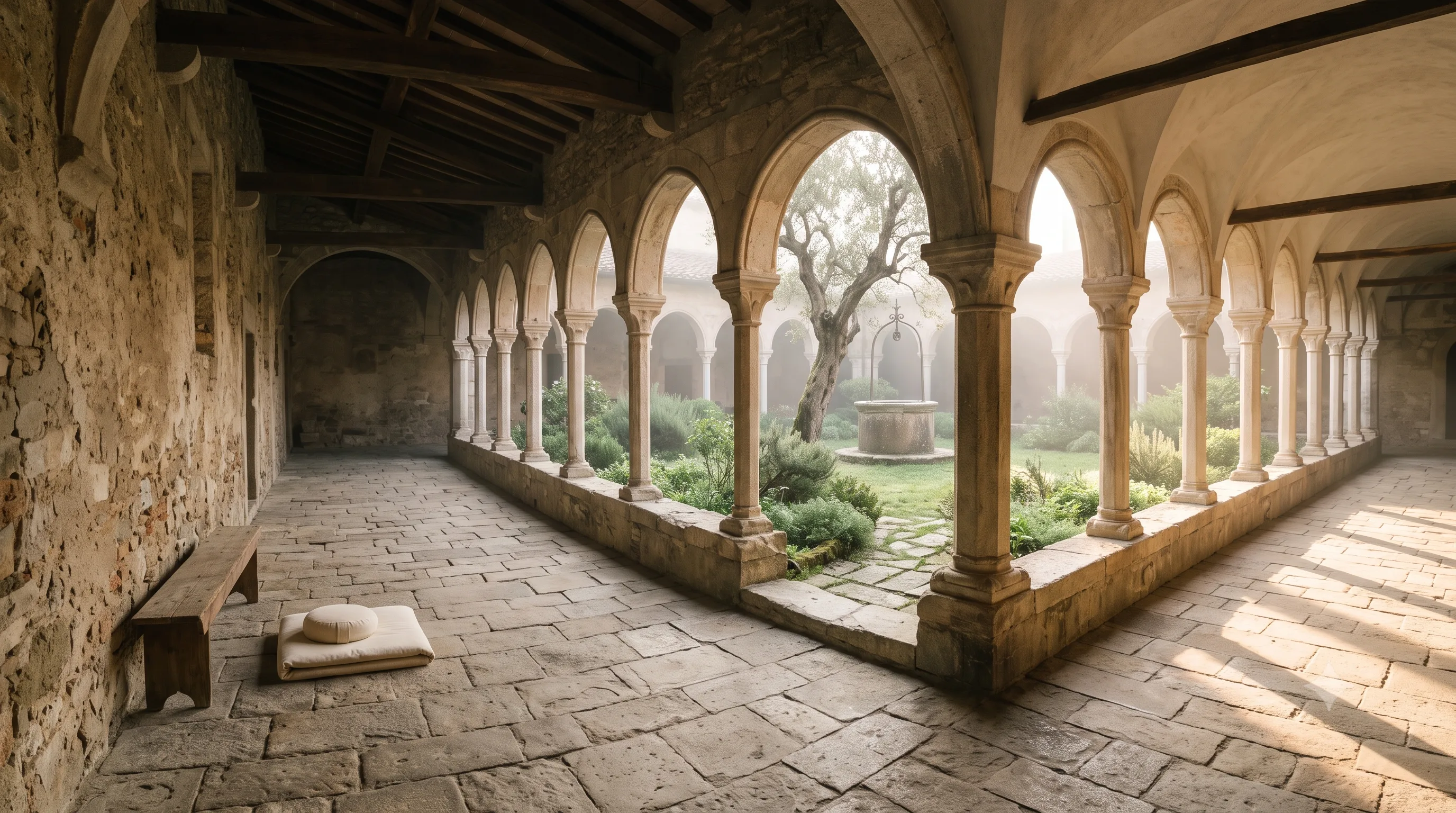
The monastery route is more classical. The German Conference of Superiors lists over 170 houses offering guest stays in its Atem holen directory; for Austria, “Gast im Kloster” bundles more than 50 monasteries. Abtei St. Hildegard in the Rheingau charges 85 euros a day with full board and states explicitly that denomination and worldview play no part in admission – joining the prayer times is voluntary. At Kloster Einsiedeln a guest stay costs 115 francs a day including meals, but prayers and meals from Lauds at 7:15 to Compline at 8 pm are compulsory. Stift Heiligenkreuz in Lower Austria charges nothing at all – but expects at least five days, practical work and a personal application.
Commercial providers sit well above that: a sesshin at the Benediktushof in Holzkirchen costs 330 euros in course fees plus roughly 90 euros a night for a single room, and a five-night silence retreat at Schloss Bettenburg runs to 890–1,100 euros all in.
Nature’s quiet – hiking and cabins
You don’t need a programme. Tyrol has designated eight quiet zones – Ruhegebiete – by statute, where cable cars for passengers and roads open to public traffic are simply prohibited. The Zillertal and Tux main ridge alone covers 421.7 square kilometres, the Ötztal Alps 394.7. It is the hardest promise of quiet in the German-speaking Alps, because it is legally binding.
Certificates help less than you’d think. The EU Environmental Noise Directive does define “quiet areas”, but obliges member states neither to designate them nor to set limits – every municipality applies its own criteria. And Quiet Parks International, the best-known quiet label, has so far certified not a single place in Germany, Austria or Switzerland; Europe’s first Urban Quiet Park was Hampstead Heath in London in 2021. Its assessment criteria are not publicly available either.
Slow travel as a quiet mindset
Silent travel needn’t be a holiday of its own. Often the quiet variant is enough: travel more slowly, plan less programme, choose the train over the plane. A night on a night train through Europe takes more haste out of a trip than any mindfulness seminar can give back – and if you are heading for cooler destinations up north anyway, the thinner crowds come free. The quiet goes furthest alone in any case: what solo travel from 40 and 50 looks like in practice we’ve written up separately.
What quiet actually delivers
This is where it gets uncomfortable, because the research is thinner than the trend suggests.
For time in nature the picture is still the best of the bunch: a review by Coventry and colleagues (2021) assessed 50 studies, 16 of them randomised trials, and found clear effects on mood and anxiety – with 20 to 90 minutes over eight to twelve weeks working best. The much-quoted rule that two hours of nature a week makes you healthier, by contrast, comes from a cross-sectional survey (White and colleagues 2019, just under 20,000 people): it shows a correlation, not a cause. And the meta-analysis on forest bathing that found lower cortisol names expectation effects as a co-explanation itself – levels in the forest group were already lower before they entered the forest.
For digital detox the balance is soberer still. A systematic review by Radtke and colleagues (2022) covering 21 studies concluded that it can currently neither be recommended nor dismissed. A 2024 meta-analysis found a small positive effect on well-being, though with very high variation between studies. And the methodologically cleanest work – a pre-registered 2025 meta-analysis with 4,674 participants – found no significant effect at all of social media abstinence on mood or life satisfaction. The largest single experiment (Allcott and colleagues 2020, 2,743 people, four weeks off Facebook) did find a real but small gain in well-being – bought with a loss of news knowledge twice that size.
And the biggest gap: on the phone-free holiday there is not a single study. All the intervention research tests abstinence in everyday life, not while travelling.
The honest catch
The effect is unproven. Book a trip as therapy and you are buying a promise without evidence. That doesn’t mean it fails – it means nobody has tested it.
Intensive meditation is not free of side effects. In a population-based US study (Goldberg and colleagues 2021), 32 per cent of meditators reported distressing experiences, 10 per cent for longer than a month; lasting impairment of daily life stayed rare at just over one per cent, and 89 per cent were glad they had meditated. The providers know this: Vipassana explicitly excludes people with serious mental health conditions, and Einsiedeln requires “a stable psychological condition”.
Not everything is open to everyone. The classic “monastery for a while” programmes at Münsterschwarzach, Heiligenkreuz and Einsiedeln admit men only, mostly aged 18 to 40. Women and older travellers are left with guesthouse stays – a different, more hotel-like product.
And the market works the label. Between zero euros at Vipassana and 1,100 euros for five nights sits the very same badge. Even large chains now market “digital detox” alongside the app-controlled room – abstinence as an optional extra to connectivity. Researchers call it selling authenticity; as a traveller, check what is concretely promised: no Wi-Fi in the building is not the same as a phone safe.
In our view: uncomfortable but worthwhile
Honestly, quiet isn’t immediately pleasant for everyone. The first hours without a phone often feel like withdrawal, and the silence can be unsettling. Anyone seeking a trip full of experiences and photos won’t be happy here – and anyone hoping to be healed is asking too much of the format.
We still think silent travel is one of the most honest reasons to travel there is. Not because a study endorses it, but because the figures on noise and stimulation are so unambiguous that a deliberate counterweight is hard to get wrong. Our advice for a first attempt: don’t start with ten days of Vipassana, start with a weekend in a house that has no Wi-Fi at all – and with a journey that is already quiet in itself.
In short
Silent travel makes quiet the destination – from a house without Wi-Fi through a monastery stay to a ten-day course in silence. The need is documented: 112 million Europeans live with too much noise, screen time is rising, the resolve to switch off is falling. The effect is not – there is no research on the phone-free holiday, and social media abstinence shows no effect in the best study available. So take the trip as an experience, not a cure. Check exactly what is promised, mind the access rules at intensive retreats – and let the quiet journey by rail become the first silent part of the trip.